
FEA Simulation
Finite Element Analysis
We use numerical methods to analyze complex structural problems involving interactions such as thermo-mechanical, FSI (fluid structure interaction), or nonlinearities (material, geometric, contact).
Work with usTENSOR excels in Computer-Aided Engineering (CAE), specializing in Finite Element Analysis (FEA). We adopt an engineering-centric approach to tackle any numerical simulation problem, ensuring your structural and thermal challenges are resolved effectively. Our FEA simulation services encompass a broad range of applications, from stress and deformation analysis to dynamic and thermal evaluations.
By leveraging advanced FEA software, we deliver accurate and reliable results that enhance the integrity and performance of your designs. Rely on our expertise to optimize your engineering projects with robust FEA solutions tailored to your exact specifications.
Outsource FEA simulation to efficiently tackle complex design challenges, ensuring structural integrity and performance optimization
Leverage FEA simulations to evaluate structural integrity under various conditions, ensuring reliability and safety of components.
Enhance manufacturing processes by predicting material behavior and optimizing design for durability and efficiency.
Assess thermal performance and manage heat transfer in assemblies to prevent overheating and ensure long-term reliability.
Our FEA simulation services effectively solve a range of critical challenges, including:
Structural Analysis
Evaluating stress, strain, and deformation in structures to ensure they can withstand operational loads and environmental conditions.
Thermal Analysis
Predicting heat transfer and temperature distribution to manage thermal loads and prevent overheating.
Dynamic Analysis
Assessing vibrational behavior, dynamic loading, and impact forces to ensure structural stability and performance under dynamic conditions.
Optimization
Refining designs to improve performance, reduce material usage, and ensure manufacturability.
Our clients feel confident and assured, knowing their designs are optimized, compliant, and benefiting from:
Enhanced Reliability
Accurate prediction of material behavior and structural response ensures long-term performance and durability.
Improved Safety
Thorough analysis and verification of designs minimize the risk of failure, ensuring safety and compliance with standards.
Cost Efficiency
Optimized designs and accurate simulations reduce the need for physical prototypes, lowering development costs and time.
Performance Excellence
Detailed simulations enable the refinement of designs for superior performance in real-world applications.
Key Features of FEA Simulation Services
Advanced Material Modeling
Simulate complex material behaviors, including nonlinear, hyperelastic, and composite materials, to ensure accurate representation of material properties.
Coupled Field Analysis
Perform simulations that involve multiple physical interactions, such as thermal-stress and fluid-structure interactions, to capture comprehensive behavior of components.
Nonlinear Analysis
Address nonlinearities in material properties, large deformations, and contact interactions to ensure realistic simulation results.
Fatigue and Fracture Analysis
Predict fatigue life and fracture behavior to assess durability and identify potential failure points in components.
Vibration and Acoustic Analysis
Evaluate vibrational characteristics and acoustic performance to ensure stability and noise reduction in mechanical systems.
Multiphysics Integration
Combine structural analysis with other physics, such as thermal and fluid dynamics for a holistic understanding of system behavior.
High-Performance Computing (HPC) Scalability
Utilize HPC resources to run large-scale simulations efficiently, enabling detailed analysis of complex models.
Optimization Tools
Use parametric, shape, and topology optimization to refine designs, improve performance, and reduce material usage.
The FEA Simulation Process
Step 1 - Preprocessing
Preparing the geometric model for analysis by creating a finite element mesh, defining material properties, and establishing boundary conditions and loads that replicate real-world operating conditions.
- Geometry Import & Cleanup: Importing the CAD model into the FEA software and simplifying complex features (fillets, holes, thin sections) to improve mesh quality without sacrificing accuracy
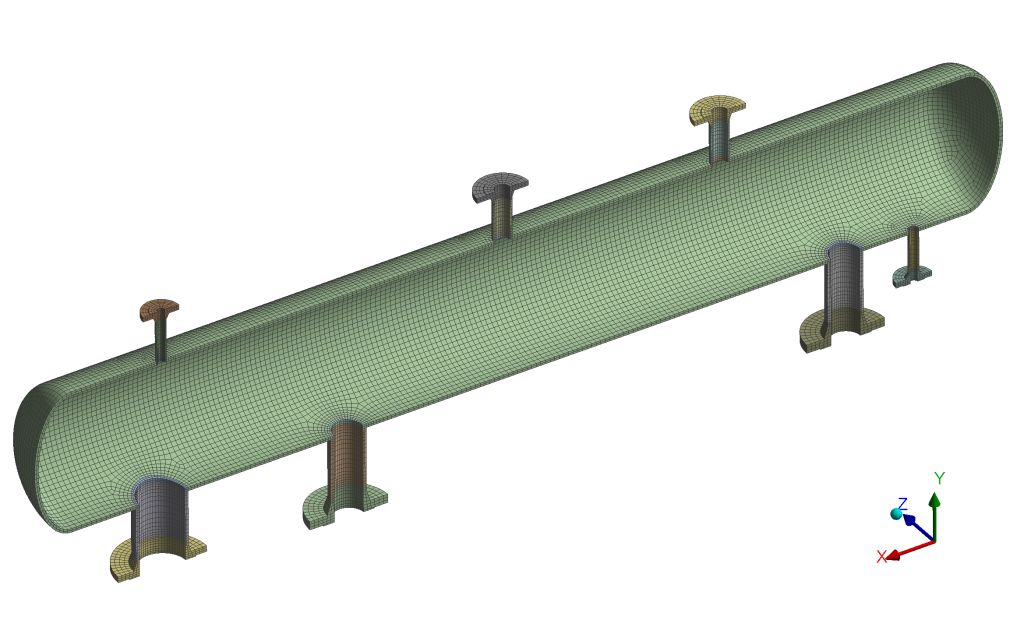
- Mesh Generation: Discretizing the geometry into finite elements (tetrahedral, hexahedral, shell, or beam elements) with appropriate mesh density in critical stress regions
- Material Properties: Assigning material models (linear elastic, elasto-plastic, hyperelastic, composite layups) with accurate mechanical, thermal, and fatigue properties
- Boundary Conditions: Defining constraints (fixed supports, symmetry conditions, contact interfaces) that represent how the component is mounted or connected
- Load Application: Applying forces, pressures, thermal loads, displacements, or acceleration fields that represent the actual service conditions
- Analysis Type Selection: Configuring the solver for the appropriate analysis type: static, dynamic, modal, buckling, thermal, or coupled-field
Step 2 - Numerical Simulation
Executing the finite element solver to compute the structural response, monitoring convergence and solution quality, and adjusting parameters as necessary to ensure accurate results.
- Solver Execution: The FEA solver assembles the global stiffness matrix and solves the system of equations using direct or iterative numerical methods
- Nonlinear Solution: For nonlinear problems, the solver uses incremental load stepping with Newton-Raphson or arc-length methods to track the response through large deformations or material yielding
- Contact Resolution: Managing contact interactions between components, including friction, sliding, and separation behavior
- Time Integration: For transient dynamic analyses, the solver advances through discrete time steps using implicit or explicit integration schemes
- Convergence Monitoring: Tracking force and displacement residuals to ensure the solution has converged to an acceptable tolerance at each increment
- HPC Utilization: Leveraging parallel computing resources for large-scale models to reduce computation time while maintaining solution accuracy
Step 3 - Post-Processing
Extracting, visualizing, and interpreting the simulation results to evaluate structural performance, identify critical areas, and provide actionable engineering recommendations.
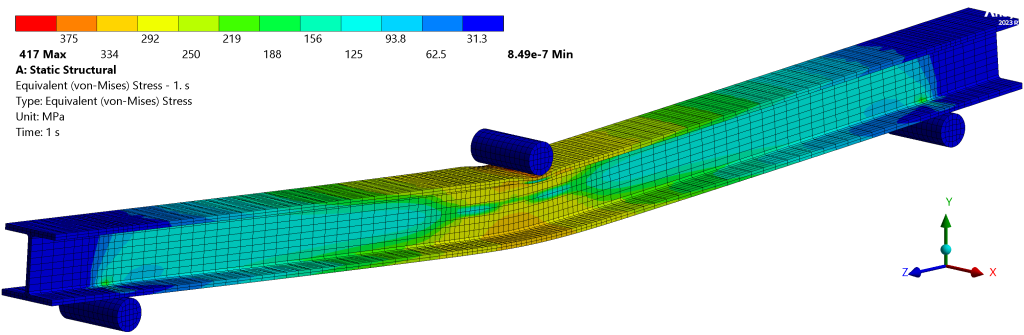
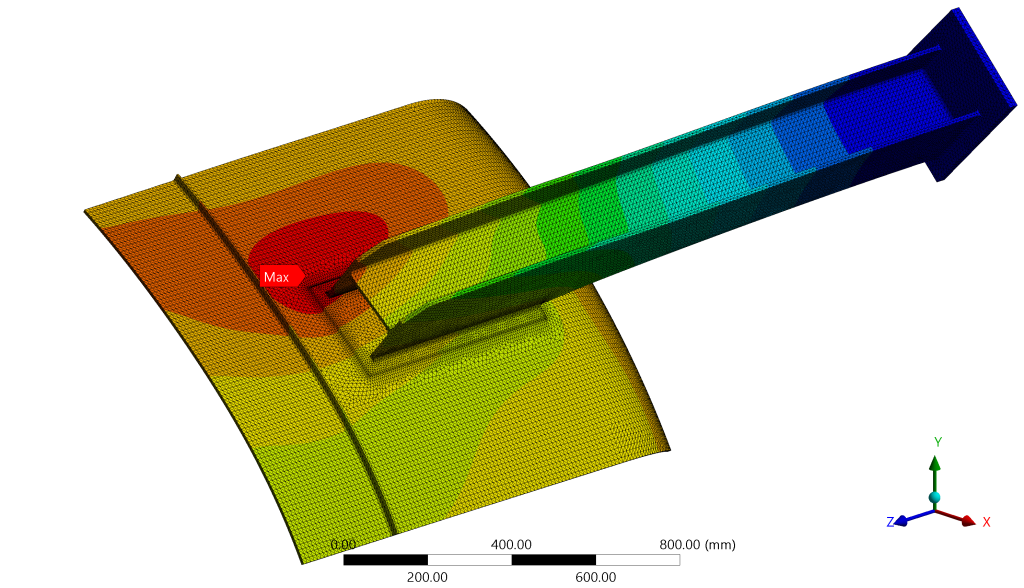
- Stress & Strain Analysis: Visualizing von Mises stress, principal stresses, and strain distributions to identify high-stress regions and potential failure locations
- Displacement & Deformation: Evaluating total and directional displacements to verify that deflections remain within acceptable design limits
- Safety Factor Assessment: Computing safety margins against yield, ultimate failure, and fatigue limits to ensure the design meets required reliability standards
- Modal & Frequency Results: Reviewing natural frequencies and mode shapes to avoid resonance conditions in dynamic environments
- Validation & Verification: Comparing simulation results against analytical solutions, experimental data, or benchmark cases to confirm accuracy
- Reporting & Documentation: Compiling detailed technical reports with contour plots, graphs, tables, and engineering conclusions for stakeholder review
Step 4 - Iterative Optimization
Repeating the simulation cycle with design modifications to improve performance, reduce weight, or address issues identified in previous iterations, driving toward an optimized final design.
- Design Refinement: Modifying geometry, material selection, or loading conditions based on simulation findings to improve structural performance
- Mesh Sensitivity Study: Refining the mesh in critical regions to ensure results are mesh-independent and converged
- Parametric Studies: Varying key design parameters systematically to understand their influence on performance and identify optimal configurations
- Topology & Shape Optimization: Using optimization algorithms to determine the most efficient material distribution or component shape for given loading and constraints
- Final Validation: Performing a comprehensive final analysis on the optimized design to confirm all performance criteria and safety requirements are met
Use our FEA simulation results analysis to predict the behavior of structures under various conditions, optimize designs, and ensure safety and reliability.
Benefit from TENSOR's expertise in CAE and our ability to solve any numerical simulation problem using FEA software.
Work with us